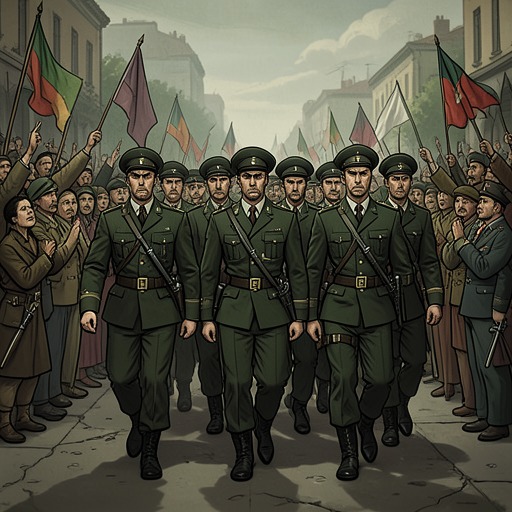
Blood Flag
The Zone of InterestThe Blood Flag is the banner Paul Doll raises during a November 9 ceremony in the concentration camp, turning a memorial speech into a political rite. Doll calls it sacred and associates it with the blood of fallen heroes, but explains that its stain is red wine. That substitution makes the object a concentrated emblem of the ceremony’s manufactured sanctity: reverence is performed through a prop, while the regime’s claims of sacrifice and renewal obscure the violence surrounding them.
Appearance and Presentation
The banner appears at the climax of Doll’s address on the Reich Day of Mourning. A podium draped with banners stands before fourteen wreaths leaning against fourteen tar-blackened flowerpots presented as urns. In the brown-tinged snow, Doll falters over his speech, slumps against the lectern, and then draws out the Blood Flag for the gathered audience to see. The scene gives the object a public, ceremonial presence, but does not describe its fabric, colors, or historical provenance; its significance comes from Doll’s presentation of it, not from any verified account of what the banner is.
Doll calls it “this sacred banner – our very own Blood Flag” and immediately qualifies its stain as symbolic, “with Rotwein.” He compares the transformation to the Eucharist. Red wine thus stands in for blood within a deliberately religious analogy: the banner is made to signify martyrdom without being shown to bear the martyrs’ blood. The blunt disclosure of the substitute makes the ritual’s construction visible even as Doll insists on its sacred meaning.
Role in the Ceremony
The Blood Flag gives Doll a focal object for shifting from an incoherent, faltering speech into an enacted ceremony. After raising it, he continues through a catalogue of medals, rings, coats of arms, torches, chants, vows, and shrines. He later kisses the flag, describes it as marked by the blood of “our hallowed heroes,” and announces that the audience will sing before observing three minutes of silence for the dead. The object links speech, gesture, collective song, and commemoration: the crowd is not simply told what the flag means but gathered into a performance of its meaning.
The ceremony is set on November 9, a date Doll presents as having several layers of political significance. He invokes 1918, 1938, and 1923, recasting defeat, the pogrom of Kristallnacht, and the failed putsch as parts of a single story of grievance and sacrifice. His account of Kristallnacht as a spontaneous popular rising is a false exculpatory framing, and the flag helps give that story a material focus. Rather than establish the truth of the historical claims, it helps Doll turn them into a ritual of collective remembrance and loyalty.
Political Sacrament and Irony
The comparison with the Eucharist makes the ceremony’s appropriation of religious form explicit. Doll treats a banner and red wine as signs of blood, sacrifice, and rebirth, then asks the audience to participate through song and silence. The form is solemn, but the disclosed wine stain and Doll’s wavering, intoxicated delivery undercut the authority of the spectacle. The object can therefore sustain both the ceremony’s intended pathos and the scene’s exposure of that pathos as staged.
The novel places such rites within a political world otherwise described through institutional calculations and mass violence. Elsewhere, a narrator caught between the Economic Administration Head Office’s demand for labor and the Reich Central Security Department’s pressure to dispose of evacuees registers the conflict in bureaucratic terms. In a later discussion, Professor Entress describes the July 31, 1941 authorization and the subsequent expansion of killing to women and children; he stresses that gas chambers and crematoria accelerated a process for which bullets and pyres would also have sufficed. Against that evidence, the Blood Flag’s language of sacred sacrifice does not redeem violence: it shows how ritual can make a murderous political order speak as though it were a community of mourners and martyrs.
The flag also belongs to a wider pattern of politically charged anniversaries. At another celebration, a joint anniversary commemorates the electoral breakthrough of September 14, 1930, alongside the passage of the Nuremberg Race Laws on September 15, 1935. The pairing makes political success and racial legislation grounds for celebration; Doll’s November 9 rite similarly turns dates and symbols into a usable myth of collective identity. The Blood Flag is especially revealing because its claim to embody blood is openly mediated by red wine: the gap between emblem and reality remains visible at the very moment the ceremony asks its audience to treat the emblem as sacred.